

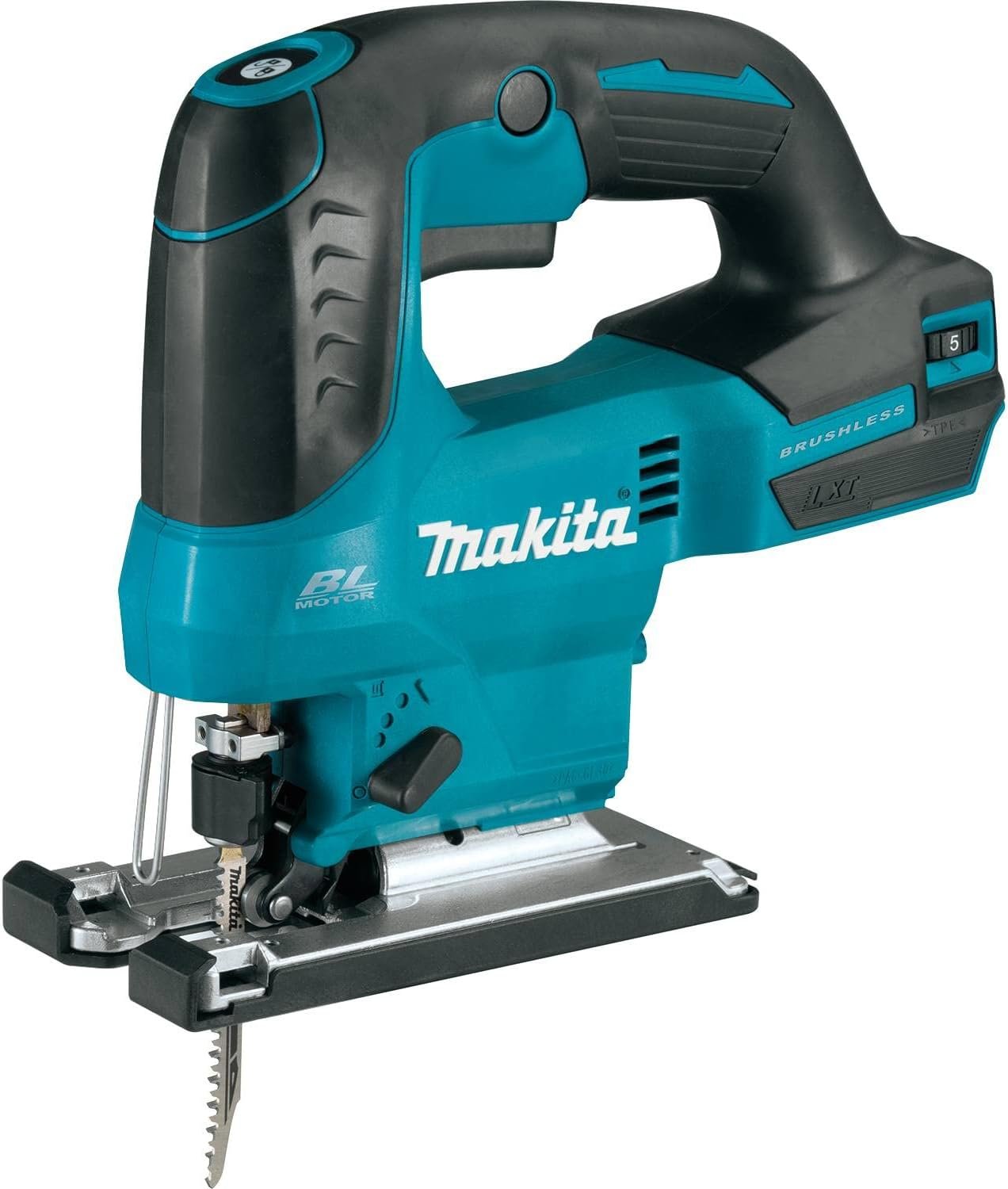
A compact, lighter D-handle jig saw with a brushless motor, soft-start mode, dual LEDs, and an electric brake. It’s about 1.2 lbs lighter than the XVJ03Z, which helps on overhead cuts and long sessions. Tool only.

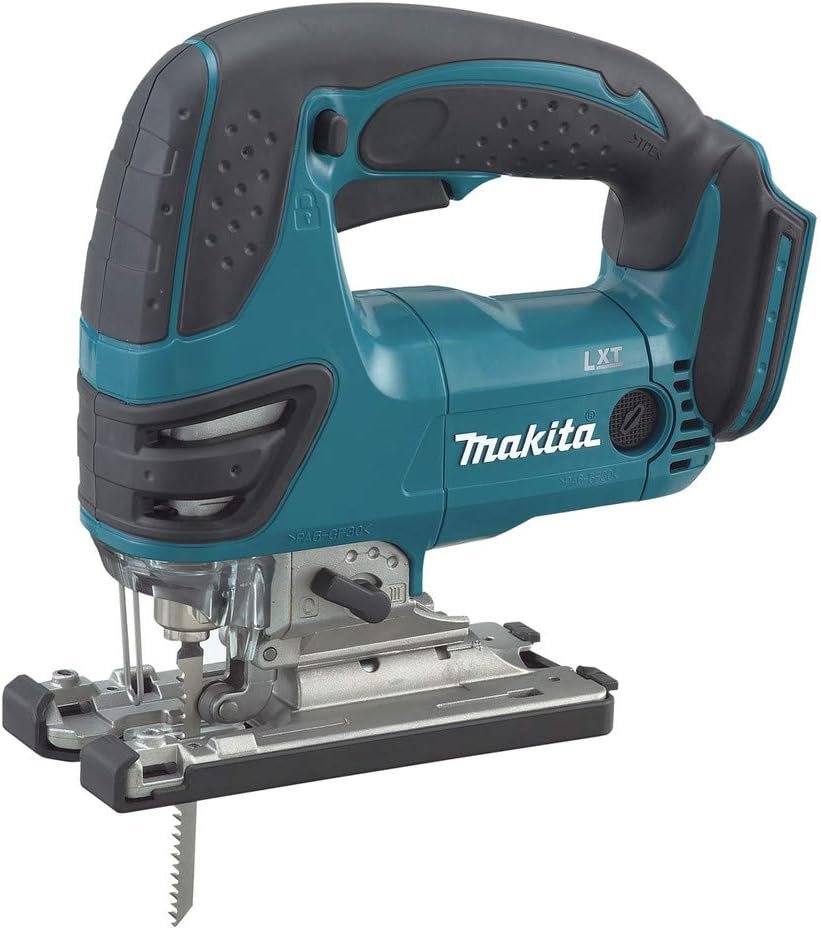
proven brushed-motor Makita with a full 1 in. stroke, 3 orbital settings plus straight cutting, and tool-less blade changes. It cuts about as fast as the XVJ04Z on paper and costs $49 less. Reviewers have praised its slow-speed control for thin stock and plastics. Tool only.
Introduction
Last Saturday, I was standing in my garage staring down at half a sheet of thick plywood, sweating over a curvy template I needed to cut out for a custom shelf project.
My old DeWalt jigsaw was supposed to make quick work of it, but the trigger control felt like an on-off switch—it either crawled or rocketed to full speed instantly, cracking the wood right at a tight corner.
Frustrated and knee-deep in sawdust, I realized I desperately needed a tool that gave me real, fine-tuned control over the blade speed right from my finger without jolting the workpiece.
That headache is what sent me down a massive rabbit hole researching Makita’s lineup, leading me straight to the classic brushed XVJ03Z with its pure trigger feel and the newer brushless XVJ04Z.
If you have ever ruined a fine cut because your saw refused to start slow and smooth, you know exactly why comparing these two specific models matters more than any spec sheet ever will.
Table of Contents
Quick TL;DR
The XVJ04Z is the better saw to hold: about 1.2 lbs lighter, shorter, and brushless. It isn’t faster, though. On published specs, the two cut at nearly the same blade speed (~219 vs ~217 ft/min). The XVJ03Z is the smarter buy for occasional use or fine, slow-speed work, and the XVJ04Z is worth for overhead, frequent, or tight-space cutting.
At-a-glance: Makita XVJ04Z vs XVJ03Z
| Features | Makita XVJ04Z | Makita XVJ03Z |
|---|---|---|
| Motor | Brushless | Brushed |
| Speed / Stroke | 0-3,000 SPM / 7/8 in. | 0-2,600 SPM / 1 in. |
| Weight (5.0Ah battery) | 5.2 lbs | 6.4 lbs |
| Length | 10.1 in. | 10.8 in. |
| Soft Start | Yes | Not listed |
| Best For | Overhead, frequent, tight-space use | Budget buyers, fine slow-speed control |
| Where To Buy? | Check On Amazon | Check On Amazon |
The “Upgrade” Speed Myth: Putting the Numbers to the Test
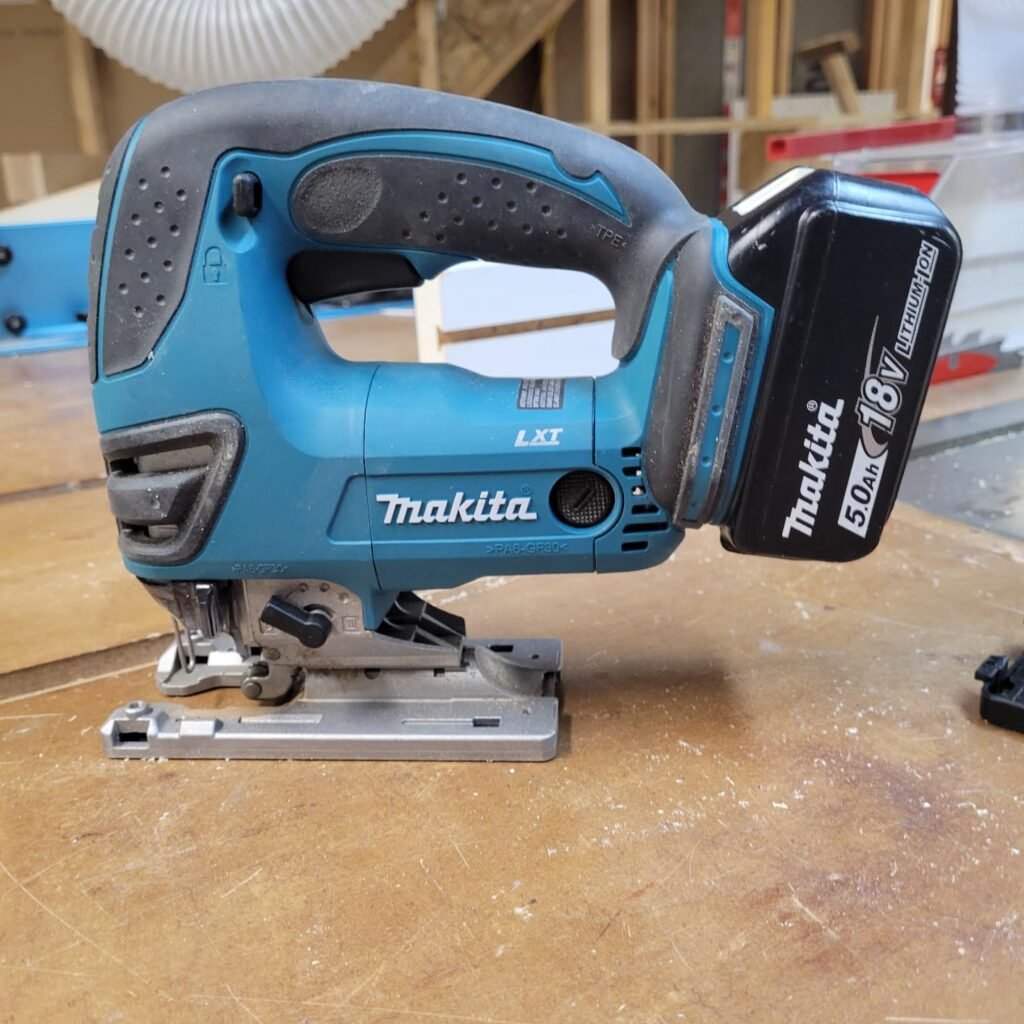
When I bought the newer XVJ04Z, I fully expected it to slice through wood much faster than my trusty old XVJ03Z, especially since the package advertises a higher speed of 3,000 strokes per minute compared to the old model’s 2,600.
But after working in my shop, I’ve learned that numbers on a box can be misleading, and that turned out to be totally true here.
What the box doesn’t highlight is that the older saw actually pushes the blade further up and down on every single stroke—a full inch compared to the new saw’s shorter 7/8 inch movement.
That means while the new saw takes slightly faster bites, the old saw takes bigger bites, making total blade movement almost identical.
To see what this actually means in real life, I took both saws to my workbench, slapped brand-new wood blades on them, and timed them ripping through thick 3/4-inch oak boards, heavy plywood sheets, and even metal pipe.
Moving down the line, both saws chewed through the material at the exact same walking pace, finishing every cut practically neck-and-neck without one ever pulling ahead.
In everyday tasks around the shop, the newer model doesn’t give you any extra cutting speed, so upgrading purely for a faster cut just isn’t worth it.
I need To Start A Cut Without The Blade Skating or Grabbing
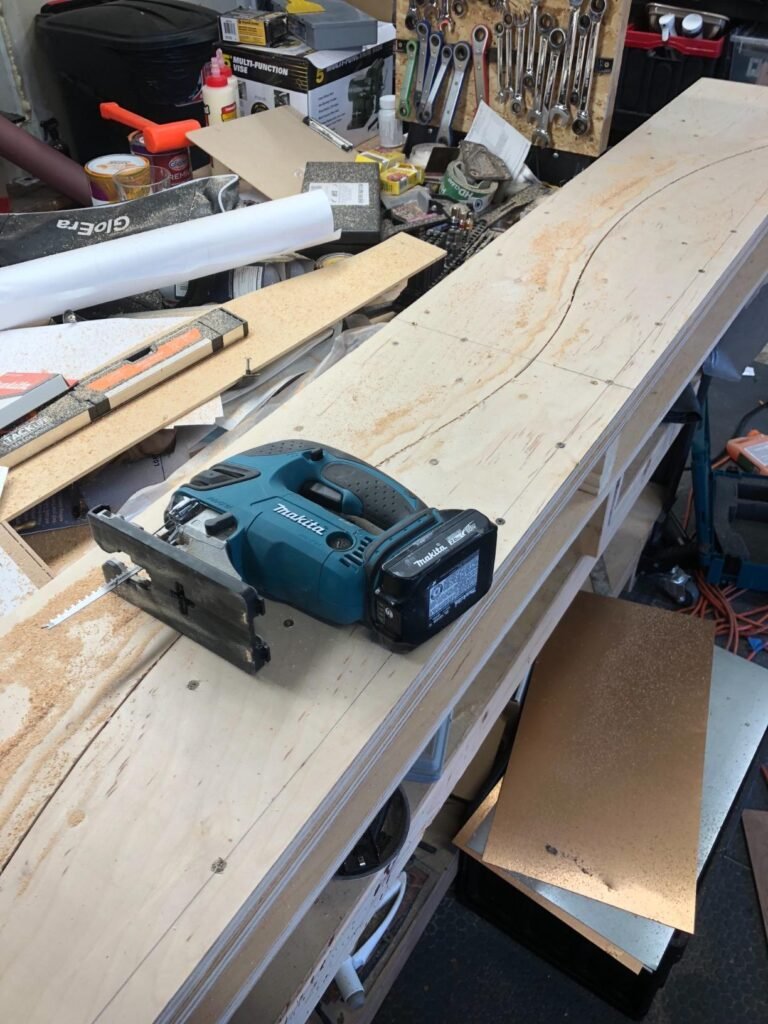
Starting a cut cleanly without damaging your material is another huge challenge with jigsaws, because a fast-moving blade can instantly skip across a smooth surface, chip away expensive wood veneer, or melt thin plastic edges together.
This is where the older, cheaper XVJ03Z surprisingly takes the crown, purely because of how its trigger behaves.
When I set up to make delicate, slow-motion cuts on fragile cabinet panels or intricate wood curves, the older XVJ03Z lets me feather the trigger with absolute precision, allowing me to crawl the blade forward as slowly as I humanly want before ramping up speed.
The newer XVJ04Z tries to fix the jumpy start problem using a smart electronic soft-start feature that automatically keeps blade speed low until it senses the teeth actually biting into the material.
While that automatic feature works great for basic cuts, it sometimes takes away that direct, hands-on control when you are trying to carefully guide a blade into a micro-thin pencil line.
For fine woodworkers, cabinet makers, or anyone working with delicate plastic sheets where total fingertip speed control is everything, the raw, predictable trigger response of the older XVJ03Z gives you a noticeably cleaner and more controlled start every single time.
I Keep Hearing Brushless Is Better
People always preach that brushless tools are automatically superior.
While that sounds great in theory, putting them through their paces in a real workshop paints a much clearer picture.
The main perk of the brushless motor on the newer XVJ04Z comes down to battery efficiency—it sips power much slower, so I could easily slice through stack after stack of lumber on a single 5Ah battery while the older, brushed XVJ03Z drained its pack noticeably faster.
Beyond the motor itself, both saws actually share essential everyday features like a tool-free blade swap mechanism that lets you eject hot blades without burning your fingers.
A solid dust blower that keeps your cut line visible, a comfortable two-finger trigger, and an instant electric brake that stops the blade dead the moment you release the switch.
Where the newer XVJ04Z truly steps up in daily use is its dual LED headlights, which light up both sides of the blade so you aren’t fighting shadows in dark cabinet corners, and its built-in soft-start mode.
So, while you won’t get a magic leap in cutting power, the extra battery runtime and better lighting on the brushless XVJ04Z make long workdays far less annoying.
Will One Of These Actually Cut The Stuff I Need?
In actual testing, both saws slice through material with almost the exact same raw capability.
Whether I was ripping through thick 2x4s or trimming thin metal sheets, the depth limits were virtually identical.
I quickly learned that what blade you pop into the quick-release chuck makes a thousand times more difference than which saw you hold.
Sliding in a fresh, fine-tooth wood blade made both jigsaws cut smooth, chip-free edges in oak plywood.
The moment I switched to a metal blade, both handled thin steel sheets without complaining.
Hands-On Note: Don’t rely on the single basic factory blade that comes in the box.
Buying a pack of quality T-shank blades matched to your exact material matters far more than any spec sheet difference between these two tools.
Which One You Should Buy?
Buy the Makita XVJ04 if:
- You want a lighter, well-balanced saw that won’t strain your arm on long cuts.
- You value battery life and want the longer runtime of a brushless motor.
- You cut overhead, trim plywood on the move, or need an easy tool to carry around the shop.
A compact, lighter D-handle jig saw with a brushless motor, soft-start mode, dual LEDs, and an electric brake. It’s about 1.2 lbs lighter than the XVJ03Z, which helps on overhead cuts and long sessions. Tool only.
Buy the Makita XVJ03 if:
- You prefer a heavier, planted feel that naturally keeps the blade steady on flat workbench cuts.
- You do delicate scrollwork or tight curved cuts where a feather-light, sensitive trigger gives you ultimate control.
- You want a tough, metal-heavy classic that has proven its durability over years of daily abuse.
proven brushed-motor Makita with a full 1 in. stroke, 3 orbital settings plus straight cutting, and tool-less blade changes. It cuts about as fast as the XVJ04Z on paper and costs $49 less. Reviewers have praised its slow-speed control for thin stock and plastics. Tool only.
Final Verdict
Ultimately, your choice boils down to how you like a tool to feel in motion.
The XVJ04 is like a light, agile sports car that flies through cuts with effortless battery savings, while the XVJ03 is like a grounded, heavy cruiser whose extra weight naturally absorbs shakes to keep your blade dead steady on flat timber.
If you want a modern, light tool that eases body strain during long days, go with the XVJ04; if you rely on heavy-tool mass to steady your hand and tame blade chatter on precise bench cuts, the XVJ03 is your best ally.
Related Articles:
FAQs
Q1. Are the XVJ04Z and XVJ03Z the same type of tool?
Yes. Both are 18V LXT cordless D-handle jig saws sold as bare tools. The main difference is the motor (brushless vs. brushed) and the body design.
Q2. Is the XVJ04Z more powerful than the XVJ03Z?
Not on the published numbers. Max blade travel works out to roughly the same for both. Makita hasn’t released torque or under-load figures, so any real-world power gap is unproven.
Q3. Do both use the same batteries?
Yes. Both accept Makita 18V LXT batteries with the star symbol. They’re sold without batteries or chargers.
Q4. Which one has the soft-start feature?
The XVJ04Z lists a soft-start mode, which Pro Tool Reviews describes as optional. The XVJ03Z’s published feature lists don’t mention it. Check the manual for how to enable or disable it.
Q5. Is the lighter weight really noticeable?
A 1.2 lb difference (5.2 vs 6.4 lbs with a 5.0Ah battery) is noticeable during overhead or extended use and matters little for short bench cuts.
Q6. Will the XVJ03Z’s brushes wear out?
All brushed motors have brushes that eventually wear. How long that takes depends on how heavily you use the saw, and for occasional users it’s usually a distant concern.