

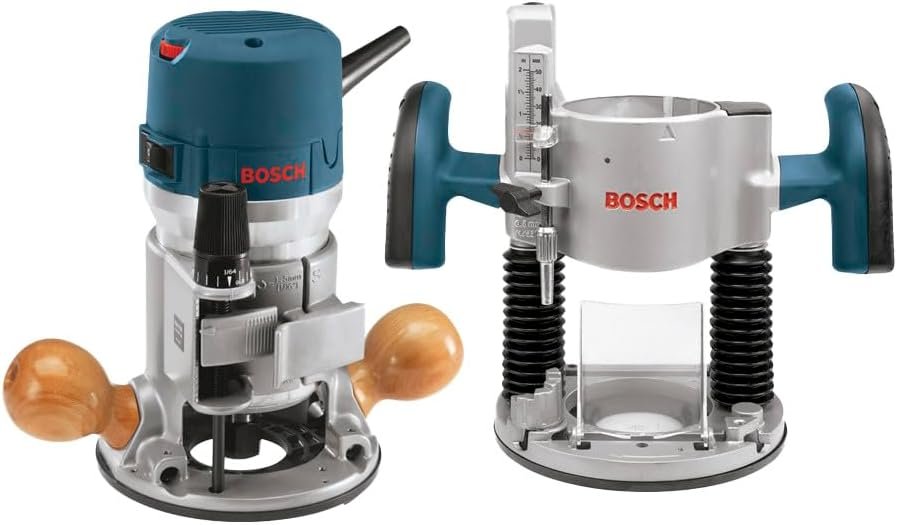
A long-standing two-base kit with a variable-speed dial (8,000–25,000 RPM) and a dust-sealed switch. Covers most hobby routing at about half the price.

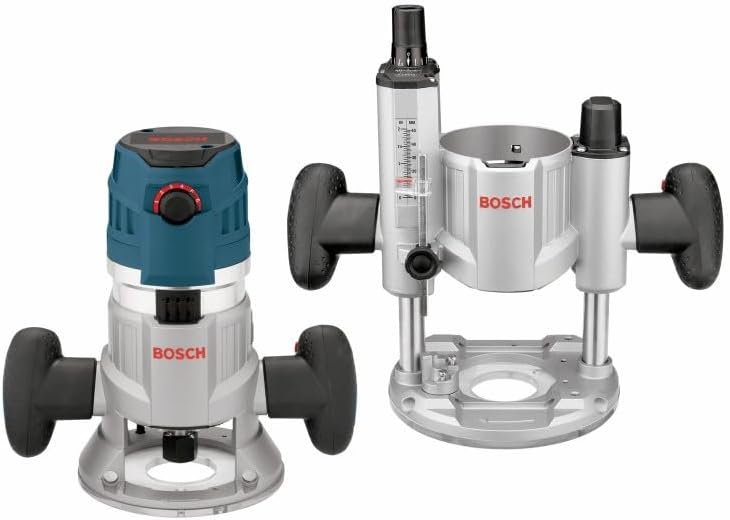
Handle-mounted trigger switches, LED light, 3" plunge travel, microfine plunge depth adjustment and soft-grip handles. Built for people who plunge often or want better controls.
Introduction
I bought my Bosch MRC23EVSK at almost double the price of the Bosch 1617EVSPK.
Both are the same basic idea: one motor, a fixed base, a plunge base and a carrying case.
The motors do differ on paper in amperage (15 A against 12 A).
But, both carry nearly the same horsepower on the label.
So why does one cost just over twice as much?
It puts the power switch right under your trigger finger on the handle.
And this completely changes how both of these tools perform in daily tasks even if they look identical twins.
Today I’m putting both to the test in my own shop to see if that trigger handle control and extra power were worth the jump in price.
Table of Contents
Quick TL;DR:
The classic Bosch 1617EVSPK is the best budget-friendly workhorse for basic edge trimming and full-time router table setups. However, if you make frequent plunge cuts or want the extra safety of handle-mounted trigger controls and LED lights, step up to the Bosch MRC23EVSK.
At-a-glance: Bosch MRC23EVSK vs 1617EVSPK
| Features | MRC23EVSK | 1617EVSPK |
|---|---|---|
| Power switch | In the handle of both bases | On the motor |
| LED work light | Yes | No |
| Plunge depth | 3 in | 2.25 in |
| Plunge depth fine-tuning | Microfine adjustment at any plunge setting | Standard |
| Handles | Soft-grip, contoured | Round, wooden |
| Speed range | 10,000–25,000 RPM | 8,000–25,000 RPM |
| Where To Buy? | Check On Amazon | Check On Amazon |
Am I Paying Double For The Same Router?
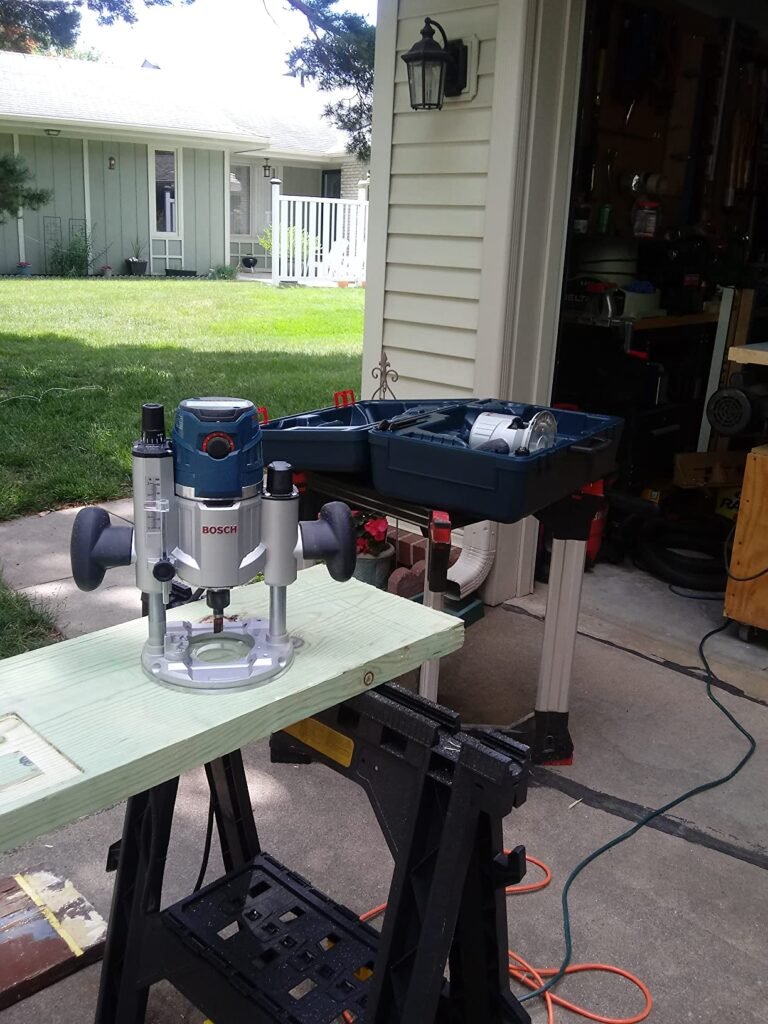
To put these specs to the test, I set up a simple trial in my shop: routing deep 1/2-inch mortises in dense white oak using the plunge bases, and edge-profiling long walnut boards with the fixed bases.
When cutting through the oak, both motors pushed through without bogging down or slowing the bit.
The extra power on paper did not make a noticeable difference in speed or cut quality.
Where the actual difference showed up was in how I worked with each machine.
With the classic 1617EVSPK, every time I hit the end of a cut or needed to pause, I had to balance the tool with my left hand while reaching up to flip the toggle switch on top of the motor.
It worked fine, but it kept my eyes off the wood for a quick second.
Switching to the MRC23EVSK changed that process completely.
My hands stayed clamped on the handles, and powering down was as simple as squeezing the trigger built right into the grip.
On top of that, the built-in LED lights illuminated the dark mortise slot, giving me a clear view of my cut lines without needing extra shop lighting.
Ultimately, you are not paying extra money for a faster motor—you are paying for smooth control, better visibility, and a workflow that keeps your hands right where they belong.
My Router’s Switch Is A Pain, Or It Dies
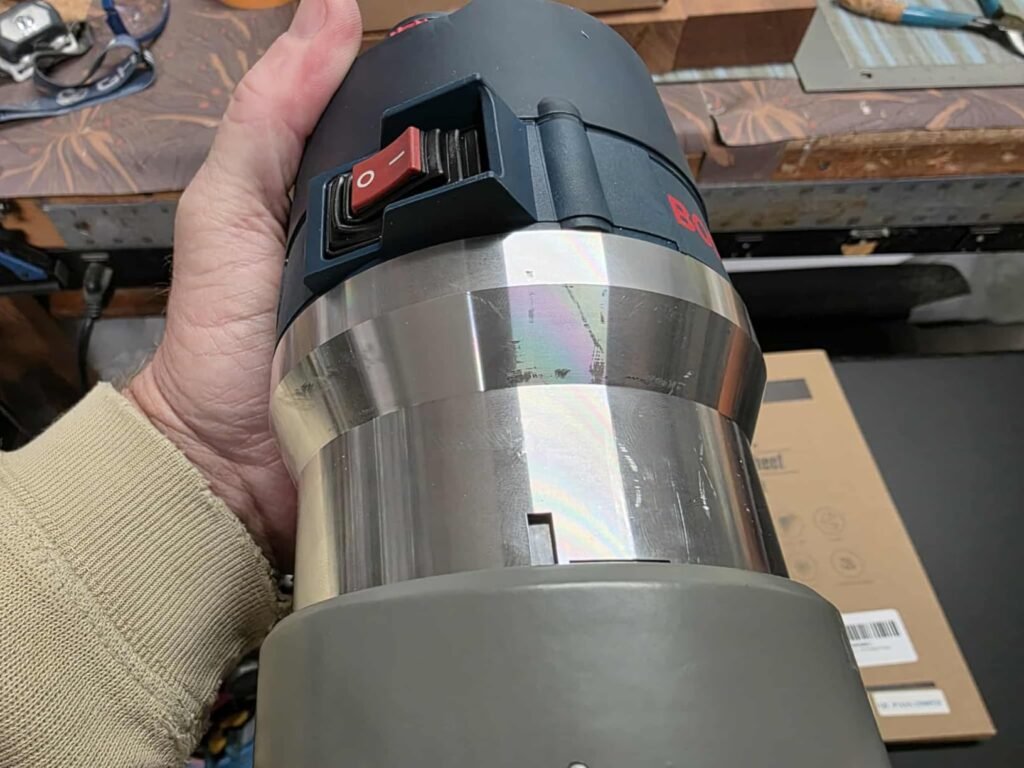
I ran into this exact switch headache while building a set of plywood shop cabinets.
After spending three straight days making dado cuts, my trusty 1617EVSPK started acting up.
First, the toggle switch felt crunchy when I flipped it.
Then, right in the middle of a cut, it refused to turn off when I reached up to hit the switch, forcing me to pull the wall plug with my free hand.
When I blew compressed air into the housing, a cloud of fine MDF dust exploded out of the switch body.
I learned later that this is a classic issue on older 1617 models because the motor fan pulls fine dust right across the switch housing.
While Bosch now uses a sealed switch on newer production runs, having a spare switch sitting on your shop shelf is practically a rite of passage for long-time 1617 owners.
When I put the MRC23EVSK through the exact same heavy routing tasks, the experience was night and day.
Bosch moved the power control to a trigger switch built right into the handle of both the fixed and plunge bases.
They solved the wiring trick by using low-voltage contacts where the motor clicks into the base, so you do not have to mess with any extra cords when swapping setups.
Squeezing the trigger on the grip felt natural, safe, and kept my hands in full control of the tool at all times.
More importantly, after weeks of tossing pine and oak dust everywhere, the handle trigger on the MRC23EVSK stayed crisp and clean, completely avoiding the gritty dust buildup that almost ruined my cabinet project with the older design.
I’ll Be Using The Plunge Base A Lot
When I built a set of hard maple workbench legs with deep mortise-and-tenon joints, the real physical differences between these plunge bases became crystal clear.
On the 1617EVSPK, plunging felt a little clunky.
I had to manually push the locking lever down to release the posts, plunge to my depth, and then push the lever back to lock it in place before starting my cut.
It felt decent, but with only 2.25 inches of travel, I almost bottomed out the tool on my deepest cuts, and adjusting depth between passes took a bit of fiddling.
Switching over to the MRC23EVSK for the exact same mortises felt like going from a basic pickup truck to a luxury car.
The spring-loaded lever automatically locks the base as soon as you release it—you just press down, plunge, let go of the lever, and start cutting without taking your hands off the handles.
It gives you a full 3 inches of smooth travel, which meant I could plunge straight down into thick timber with room to spare.
On top of that, its Afterlock microfine adjustment let me tweak the cutting depth in tiny fractions while the motor was still locked in the plunge position, saving me a ton of setup time when sneaking up on a perfect fit.
Will It Wear Me Out, Or Feel Clumsy In My Hands?
When spending hours shaping long hardwood moldings, how a router feels in your hands matters just as much as what motor is inside.
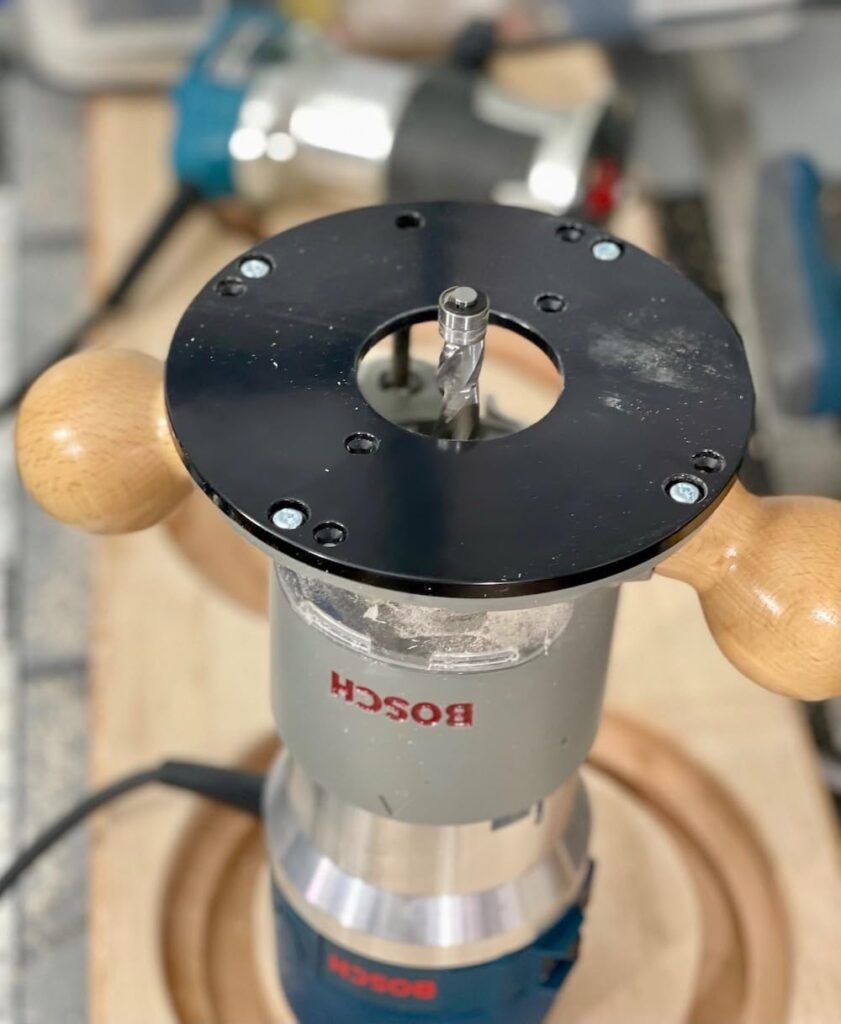
The 1617EVSPK comes with classic round wooden handles on its fixed base.
They look great and give the router a traditional charm, but after an hour of non-stop edge trimming, my hands started to feel cramped.
Because they are smooth wood, I found myself gripping harder than necessary just to keep full control.
Every once in a while, one of the knobs would even vibrate slightly loose, forcing me to stop and tighten it down mid-job.
When I grabbed the MRC23EVSK, the grip difference was immediate.
Bosch replaced the wood knobs with ergonomic, rubber-molded handles shaped to fit your palm.
Squeezing the built-in trigger right from the handle felt natural, and the soft rubber grip absorbed a lot of the high-frequency motor vibration that usually numbs your fingers after long passes.
The tradeoff comes down to total weight.
On paper, I got confused by total box shipping weights, but holding both tools in the shop tells the real story: the MRC23EVSK is noticeably chunkier.
When routing flat tabletop edges, that extra weight works in your favor by keeping the base planted flat with zero chatter.
But if you plan on doing freehand sign carving or holding the router vertically against a wall frame, that extra heft will wear out your shoulders a lot faster than the lighter 1617.
I Want To Mount It In A Router Table
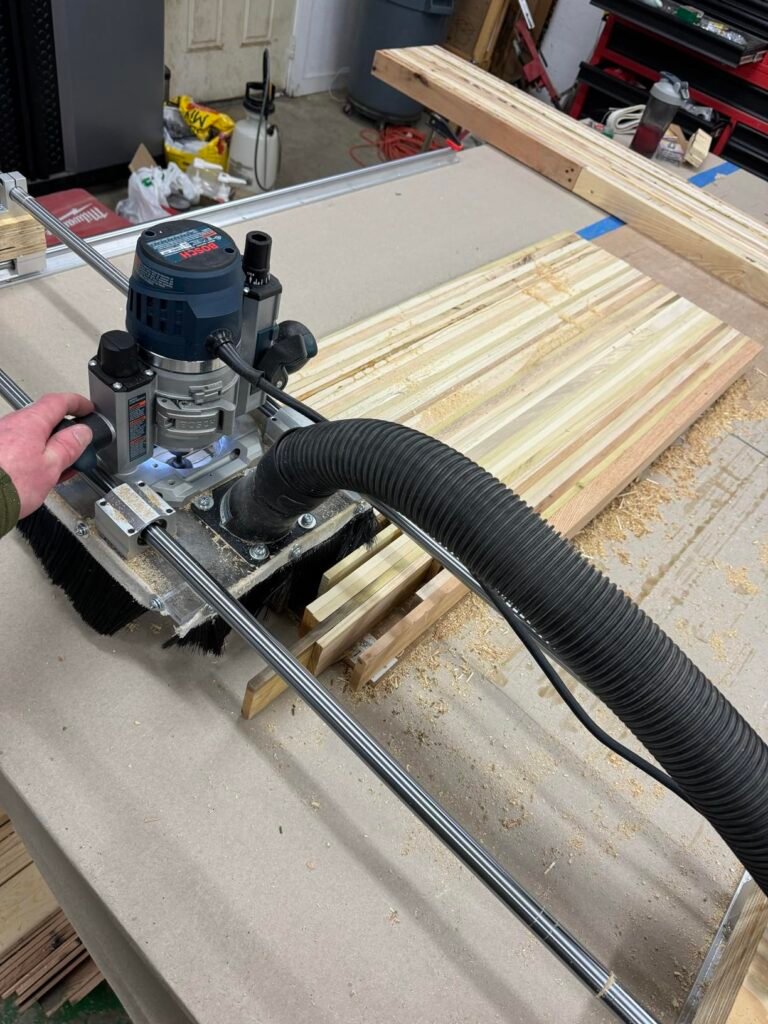
I eventually inverted both fixed bases and bolted them into my router table top to see how they handled life as dedicated table tools.
The classic 1617EVSPK has been a router-table favorite for years, and it is easy to see why.
The fixed base includes a hole right through the sub-base that lets you stick a T-wrench in from the top of the table to dial in bit height.
In practice, though, it is not a complete magic trick.
You still have to reach under the table to unclamp the motor base before the wrench can turn the height screw, adjust your height, and then reach back underneath to lock it tight.
Changing bits was also a two-wrench, under-the-table workout since the spindle never rises far enough above the plate to clear the collet nut.
When I mounted the MRC23EVSK, I expected a massive upgrade, but the results were a mixed bag.
On the positive side, dialing in bit height from above the table worked smoothly.
Reaching the variable-speed dial under the table was surprisingly easy, and the motor had all the muscle in the world for spinning wide panel-raising bits without stuttering.
However, the MRC23 proved to be a bit clumsy under the hood.
Because of its built-in handle electronics and heavier housing, it is a big, bulky unit to maneuver in a tight table cabinet.
Worse, just like the 1617, the collet nut does not sit high enough above the tabletop for easy above-table bit changes.
You still have to duck underneath with your wrenches every time you swap cutters.
If you want a setup that lives in a table full-time, both will work—but neither replaces the convenience of a true dedicated router lift.
Bosch MRC23EVSK vs 1617EVSPK: Which One You Should Buy?
Buy the Bosch 1617EVSPK if:
A long-standing two-base kit with a variable-speed dial (8,000–25,000 RPM) and a dust-sealed switch. Covers most hobby routing at about half the price.
- You want a light, proven classic: You want a reliable shop motor that won’t wear out your arms during long, freehand routing sessions.
- You are on a budget: You prefer saving around $150 and don’t mind reaching up to the motor to flip the toggle switch.
- You want a permanent table router: You plan to leave the fixed base mounted under your router table full-time, where handle triggers don’t matter as much.
Buy the Bosch MRC23EVSK if:
Handle-mounted trigger switches, LED light, 3" plunge travel, microfine plunge depth adjustment and soft-grip handles. Built for people who plunge often or want better controls.
- You do a lot of plunge work: You make mortises, stopped grooves, or template cuts and need the extra 3 inches of travel and smooth auto-locking lever.
- Safety and control are top priorities: You want the power trigger right on the handle so you never have to take a hand off the tool while it is spinning.
- You want built-in lights: You often cut in dark spots or deep mortises where built-in LED lights make tracking line marks much easier.
Final Verdict
Choosing between these two routers isn’t about raw power—it’s about how much daily frustration you’re willing to pay to eliminate.
If your router lives upside down in a table or only comes out for basic edge profiles, the classic 1617EVSPK gives you every ounce of performance you need while keeping extra cash in your pocket.
But if you spend serious time making deep plunge cuts, chasing perfect mortises, or hate taking your hands off a spinning tool just to turn it off, the MRC23EVSK pays for itself in sheer safety, comfort, and control.
Related Articles:
FAQs
Q1. Is the MRC23EVSK worth $154 more than the 1617EVSPK?
It depends on whether you’ll use what the money buys: handle-mounted switches, deeper plunge travel and microfine plunge adjustment, LED lighting and soft-grip handles. If you won’t, the 1617EVSPK is the better value.
Q2. Is the MRC23EVSK more powerful?
On the label, the difference is tiny: 2.3 HP versus 2.25 HP. Owner discussions focus on controls and ergonomics rather than cutting performance.
Q3. Do both kits include a plunge base and a fixed base?
Yes. Both are two-base kits with a carrying case.
Q4. Is the 1617EVSPK still sold?
Yes. It still has active retail listings and recent customer reviews, with Bosch customer support responding to reviews as recently as May 2026.
Q5. Can I use either router in a router table?
Both have threaded three-hole base patterns. Check compatibility with your specific table or lift before buying, and consider whether a larger dedicated table router suits your work better.