

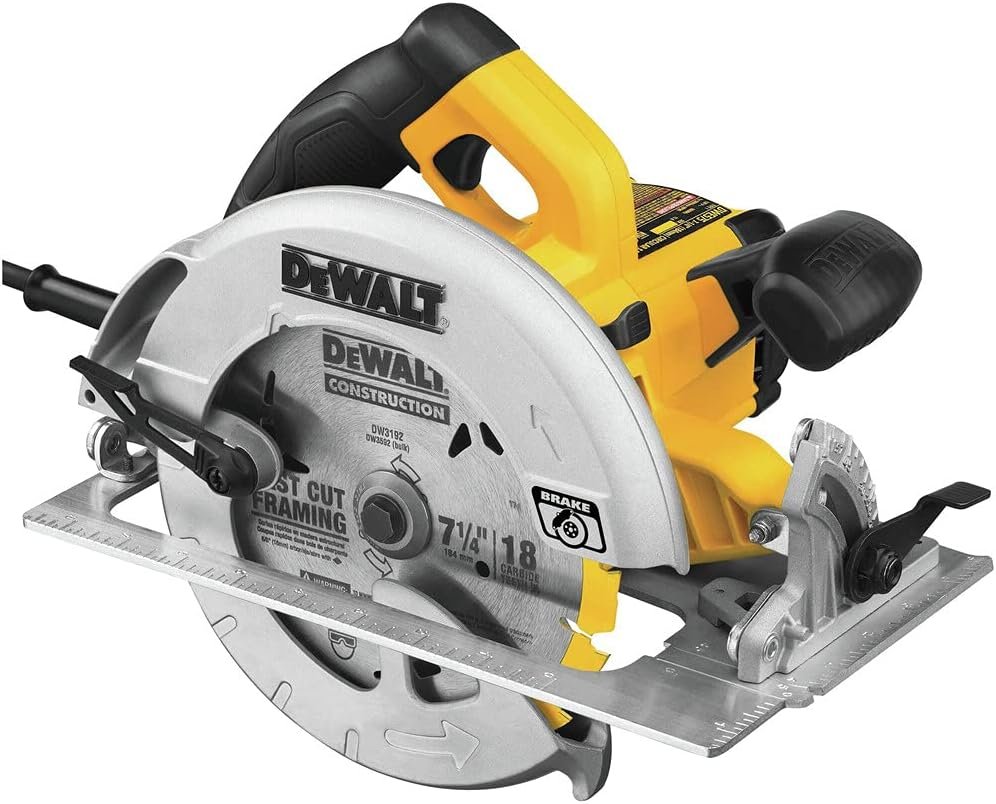
Lightweight 8.8 lb corded saw with a 15-amp motor, electric blade brake, and a ball-bearing lower guard that retracts smoothly. The full-width aluminum base suits guided cuts on plywood and OSB. Check alignment out of the box, and consider a better blade for finish work.

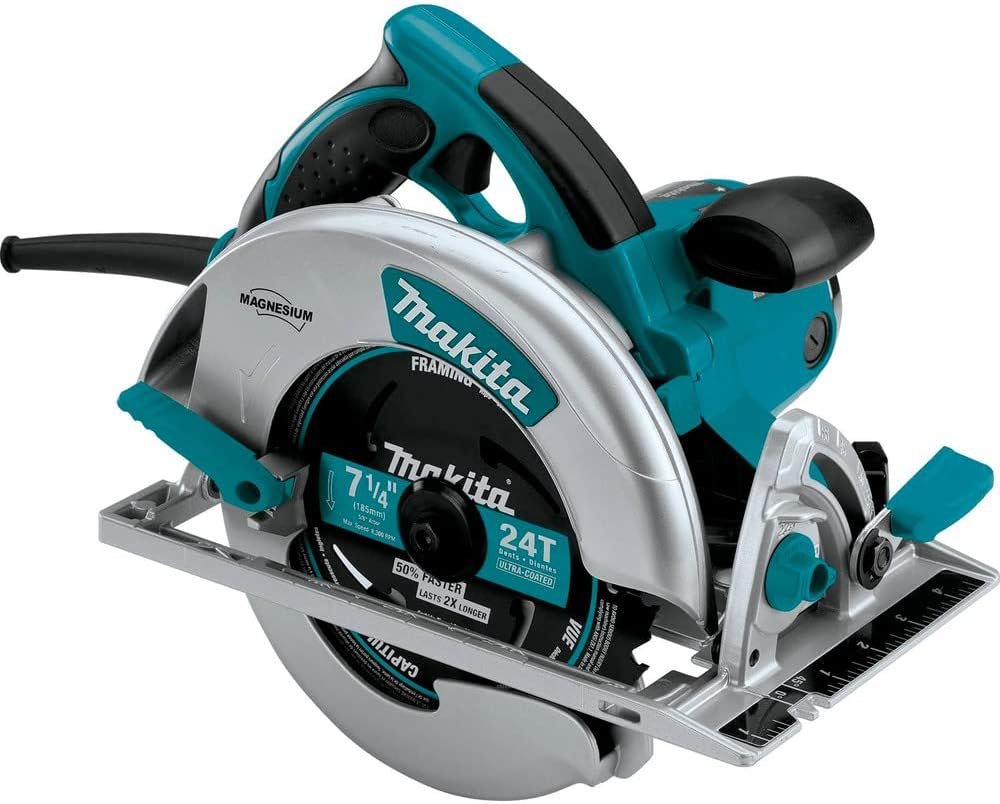
Magnesium-component 15-amp saw with two integrated LEDs and a premium framing blade included. Owners praise its balanced, planted feel and the brand's durability reputation. At about 10 lb it's heavier than the DeWalt, and the cut-away left side of the base can be awkward for guided sheet-goods cuts.
Introduction
Both of these are 15-amp, 7-1/4″ corded sidewinder saws.
Both will rip through a 2×4 without complaint.
This is exactly what I though when I bought these saws.
But after just 1 week of consistent use the difference started showing up in the details.
How the saws felt late in the day, what happened when I run it along a guide, whether the stock blade held up, and whether the price gap was worth it.
Table of Contents
Quick TL;DR:
If your wrists and shoulders are the bottleneck, the DeWalt has the edge. It is about 1.8 lb lighter on paper. If you want a saw that feels balanced and planted in a long framing session, the Makita has a loyal following.
At-a-glance: DeWalt DWE575SB vs Makita 5007MG
| Features | DeWalt DWE575SB | Makita 5007MG |
|---|---|---|
| Weight (listed) | 8.8 lb | About 10.1-10.6 lb |
| Base | Aluminum, full-width | Magnesium, cut-away left side |
| Depth of cut (90°) | 2-9/16" | About 2.5" |
| Max bevel | 57° (stops at 22.5° and 45°) | 0° to 56° |
| Electric brake | Yes | No |
| Stock blade | Basic; upgrade prefered | Premium framing blade included |
| Best for | Long days, guided sheet goods, lower cost | Balanced feel, framing work |
| Where To Buy | Check On Amazon | Check On Amazon |
Weight And Fatigue
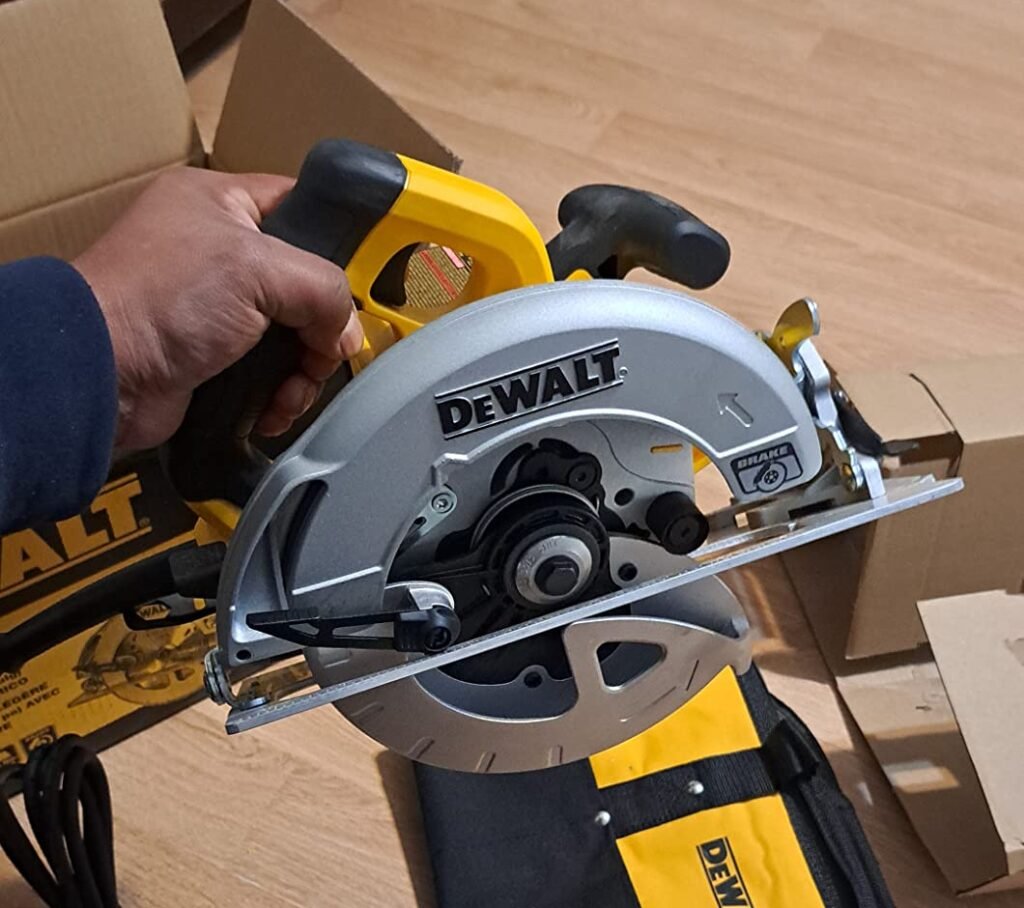
When you look at the specs online, a 1.5-pound difference between two saws does not sound like a big deal.
But your body feels every single ounce after a long day of work.
To test how this weight actually affects you on the job, I used both saws back-to-back during a full day of framing out a deck.
I spent the morning making continuous crosscuts on 2×6 boards with the Makita 5007MG, then switched to the DeWalt DWE575SB after lunch.
By 2:00 PM, the difference was night and day.
The Makita 5007MG weighs right around 10.6 pounds.
It feels incredibly solid and stable when you lay it flat on a piece of plywood, but every time you lift it to reset for the next cut, you feel that extra bulk.
By mid-afternoon, lifting that extra pound and a half hundreds of times starts to pull on your forearm and shoulder.
If you are doing overhead cuts or holding the saw sideways to trim joist ends, your wrist feels completely shot by 4:00 PM.
Switching to the DeWalt DWE575SB felt like dropping a weight off my wrist.
At just 8.8 pounds, it is remarkably lightweight and nimble.
I could glide through cuts, pick it up, and position it for the next pass using one hand without straining my arm.
Here is how to think about it in the real world: if you lift your saw 200 times during a workday, carrying that extra 1.5 pounds on the Makita means your arm is lifting an extra 300 pounds of weight over the course of the day.
If you cut all day long or work up on scaffolding, the lightweight DeWalt will save your body a ton of wear and tear.
The Makita Base Issue
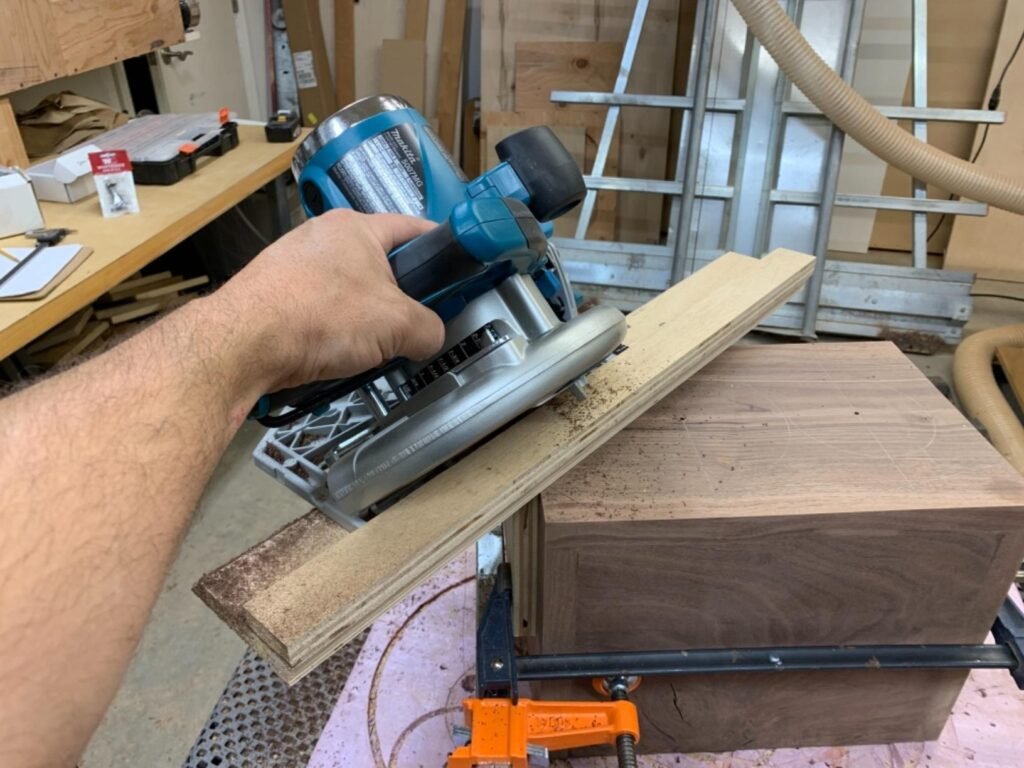
If you plan to cut big sheets of plywood using a straight edge or guide rail, this one design detail on the Makita could completely catch you off guard.
When I clamped down my straight edge to rip a 4×8 sheet of 3/4-inch plywood, I ran into an immediate problem with the Makita 5007MG.
The left side of its magnesium base plate is cut away, making that front edge much shorter and narrower than normal.
When you push the saw along a straight guide, you want a wide, flat base riding flush against the edge so the saw stays straight and does not wobble.
With the Makita, because so much metal is cut out on that side, there is very little base touching the guide.
As I reached the middle of the sheet, the front corner almost slipped under my straight edge, tilting the saw and causing the blade to bind in the wood.
I had to pay twice as much attention just to keep the saw running straight.
Switching over to the DeWalt DWE575SB was a completely different story.
The DeWalt comes with a traditional, full-sized aluminum base plate.
When I set it against my straight edge, it felt solid, planted, and easy to slide without any twisting or slipping.
It gave me a straight, smooth cut on the very first try with zero stress.
That cutaway base on the Makita isn’t a dealbreaker for everyone—some people like it because it shaves off weight, and others just screw an aftermarket base plate to the bottom to fix it.
But if your main work involves ripping sheet goods with a guide rail right out of the box, the DeWalt’s wide, flat base makes the job much safer and easier.
I’ve Heard The Brake Fails!
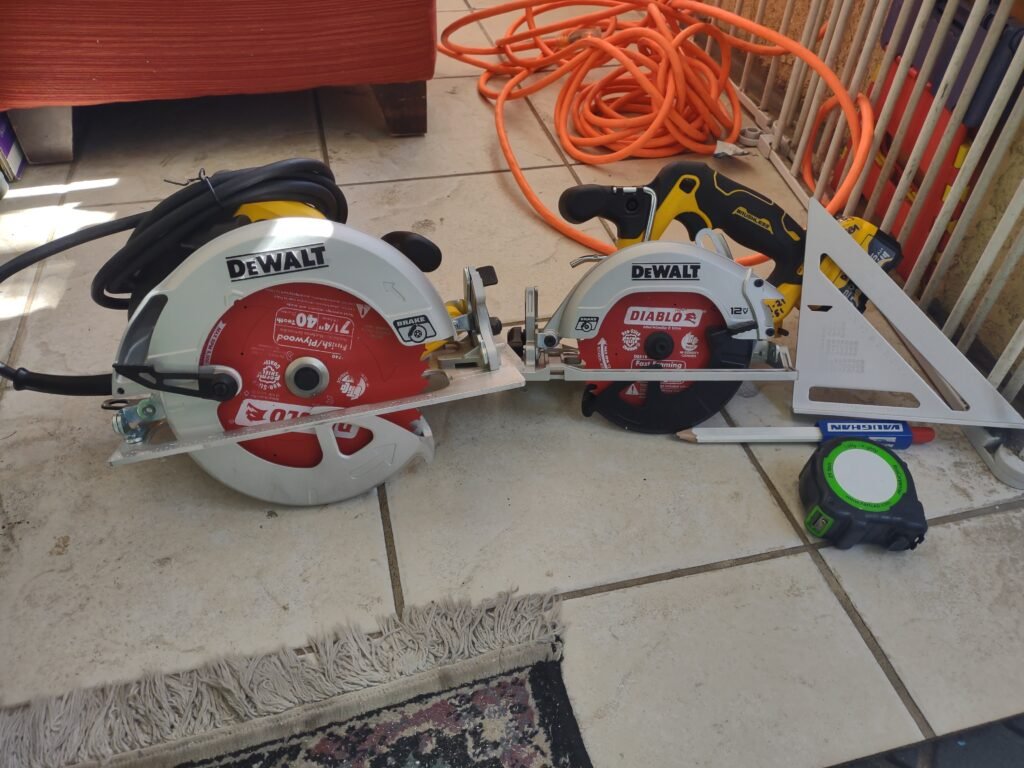
When you release the trigger on a circular saw, those few seconds while the blade spins down feel like an eternity.
That is usually when accidents happen—when you set a fast-spinning blade down on a sawhorse or near your extension cord.
The “SB” in the DeWalt DWE575SB stands for electric brake, and on the job site, it changes how you work completely.
During my testing, every single time I let go of the trigger, the DeWalt brought the blade to a full stop in about two seconds.
That meant I could finish a cut, set the saw down on the workbench immediately, and pick up my next board without standing around waiting.
I had heard rumors online that the electric brake on the DeWalt dies after a few months, so I paid close attention to it.
After hundreds of cuts through damp, pressure-treated lumber, the brake held up without missing a beat.
The lower blade guard on the DeWalt was another massive safety win.
On older or cheaper saws, the guard tends to catch on the edge of the wood when you make steep angle cuts or trim thin pieces, forcing you to reach over and pull it back by hand—a dangerous habit.
But the DeWalt’s guard rolled back effortlessly on ball bearings every single time, even on tight bevel cuts.
If you want peace of mind on the job site, the fast electric brake and smooth blade guard on the DeWalt make it a much safer tool to run all day long.
What About The Small Stuff That Affect Daily Use?
When you use a saw every single day, it is often the tiny features—the ones that don’t make the front cover of the box—that end up driving you crazy or making your life easier.
Sightlines: Blower vs. Lights
The Makita 5007MG comes equipped with twin LED lights that instantly flood your cut line with light the moment you pull the trigger. When I had to trim floor joists inside a dark, poorly lit basement, those lights were an absolute lifesaver. However, out in the bright sun, LEDs do not help much against sawdust buildup.
That is where the DeWalt DWE575SB wins outdoors. Instead of lights, it features a built-in dust blower that directs air right in front of the blade. As I pushed through long cuts, it blasted the sawdust off my pencil line so I never had to stop and blow the dust away with my mouth.
Cutting Depth and Bevel Capacity
On paper, the DeWalt gives you a maximum cutting depth of 2-9/16 inches, while the Makita sits at 2-1/2 inches. In the real world, that tiny 1/16th of an inch difference changes absolutely nothing. Both saws effortlessly slicing through standard 2x4s and 2x6s in a single pass, and neither saw can cut straight through a thick 4×4 post without flipping it over first.
Convenience Details
- On-Board Wrench: Both saws store the blade-change wrench directly on the body. On the DeWalt, it snaps neatly into the rear handle, while the Makita keeps it tucked along the base. Either way, you won’t be tearing your tool bag apart when it’s time for a fresh blade.
- Storage Cases: My DeWalt came with a soft fabric contractor bag, which is great for tossing extra blades and safety gear inside. The Makita, on the other hand, usually ships with a heavy-duty hard plastic case that offers much better impact protection in the back of a truck bed.
Which One You Should Buy?
Lightweight 8.8 lb corded saw with a 15-amp motor, electric blade brake, and a ball-bearing lower guard that retracts smoothly. The full-width aluminum base suits guided cuts on plywood and OSB. Check alignment out of the box, and consider a better blade for finish work.
- Buy the DeWalt DWE575SB if you work outdoors all day. It is much lighter, so your arm won’t get tired. It has an electric brake that stops the blade safely in two seconds, a flat base that works great with straight guides, and a dust blower that keeps your line clean in the sun.
- Buy the Makita 5007MG if you work indoors or in dark spaces. Its bright built-in LED lights make it super easy to see your mark in dim rooms, and it comes with a tough hard case to protect it in your truck.
Final Verdict
At the end of the day, your choice comes down to how you plan to use the saw.
If you want a tool that protects your body during long workdays, go with the DeWalt DWE575SB.
Its lighter frame reduces wrist strain, and its quick electric brake lets you work faster and safer.
But if you value rugged durability and frequently work in poorly lit spaces, the Makita 5007MG remains a reliable workhorse that can take a beating.
Choose the DeWalt for pure comfort and speed, or the Makita for heavy-duty toughness and dim-light visibility.
Related Articles:
FAQs
Q1. Does the DeWalt really need a blade upgrade?
Not necessarily. One owner’s only complaint was the stock blade, and a professional reviewer swapped it, but that is a preference, not a defect. A better blade is a cheap way to improve either saw.
Q2. Is the Makita’s cutaway base a dealbreaker?
For guided sheet-goods cutting, it can be. Owners also report fixing it with an aftermarket base.
Q3. Which one is safer?
The DeWalt SB has an electric brake and an easy-moving ball-bearing guard. Check the Makita’s brake status on its spec sheet. Whichever saw you choose, check blade stop and guard return when it’s new.
Q4. Which is better for a beginner?
The DeWalt is lighter, cheaper, and has a forgiving guard, so it’s a sensible first saw. The Makita is easier to justify once you’ve done enough cutting to know what you prefer.